
The October 22, 2026 0-V.E.R. INT-DFIR Report in analyzing the PHP2Shell (PHP) Cyber Emergency that court’s continued dependence on the full trust chain of federal cyber infrastructure, including legacy servers and end-of-life endpoints, presents greater dangers in light of the authority, intake, and routing compromises disclosed in August 2025.
Jay Lewis Farrow | Contributing Author
A second cyber emergency arrives while the Judiciary is still rebuilding
October 25, 2026 – WASHINGTON, D.C., NEW YORK, MIAMI, LOS ANGELES: The federal judiciary already had a cyber emergency before PHP2Shell arrived. On August 7, 2025, the Administrative Office of the U.S. Courts publicly acknowledged escalated cyberattacks of a sophisticated and persistent nature against the Judiciary’s case-management system and announced additional protections for sensitive documents.
In March 2026, federal judges said modernization of CM/ECF had been accelerated because of the ‘acute and persistent risk’ facing the system. By September, the Judicial Conference was still reporting case-management modernization as an urgent security project.
Against that background, the October 22, 2026 0-V.E.R. INT-DFIR report asks a question that matters to every federal practitioner and court administrator: what happens when a separate public-facing website, email system, cloud credential or service provider becomes the route by which a trusted judicial instruction is changed before it reaches the filing system?
PHP2Shell Cyber Emergency and Implications to Existing Legal-Sector Vulnerabilities examines CVE-2026-109618 and CVE-2026-109619, two critical PHP vulnerabilities that can permit unauthenticated remote code execution in vulnerable web-serving environments. PHP released emergency corrections on October 21.
Amazon Threat Intelligence subsequently reported an attempted exploit in MadPot telemetry on October 17, four days before public disclosure. The report was prepared by the private-sector 0-V.E.R. INT-DFIR Team, with Jay Lewis Farrow serving as lead author, research coordinator and final editor.
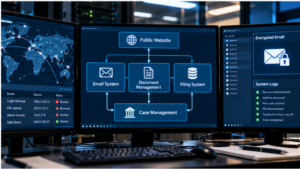
Editorial image prepared for publication use; legal-sector cyber operations illustration.
The weak point may sit outside the filing system
Its federal-court significance lies in separation of systems. A court’s public website is not the same thing as CM/ECF. PACER is not the same thing as a clerk’s intake process.
Email authentication is not the same thing as human authorization. A paper submission is not the same thing as the scanned image later associated with a docket. Yet those systems and stages exchange instructions, identities, documents and status information. The report’s method is to preserve each stage and then reconstruct the transition between them.
That approach tracks the Judiciary’s own public experience. POLITICO reporters John Sakellariadis and Josh Gerstein first reported the 2025 federal filing-system breach; Reuters cybersecurity reporter Raphael Satter documented the Judiciary’s subsequent acknowledgment. The 0-V.E.R. report expressly credits those journalists, along with WIRED’s Matt Burgess, BleepingComputer reporters and technical authors such as AWS’s CJ Moses, for preserving the public chronology around both court-system security and the October PHP emergency.
The report does not treat those stories as interchangeable evidence. Instead, it uses public reporting to anchor dates and institutional responses, while vendor advisories, court records and provider telemetry control the technical conclusions. That source discipline is one of the report’s stronger features because federal cyber incidents often generate overlapping public accounts before complete technical records are available.
A filing is a chain of custody, not a single click
The practical court-workflow guidance is more important than the headline vulnerability. For a time-critical matter, the report directs counsel to preserve the original submitted document, the acknowledgment, the case association and the service notice as separate objects.
If a filing route or public instruction is in dispute, the lawyer should contact the clerk through a number verified independently of the questioned website or message and obtain the court-specific emergency procedure. If paper delivery is authorized, the physical receipt is preserved separately from the later scan, docket association and electronic service.
That matters because a technically successful submission can still produce a contested institutional state.
The wrong recipient list, an altered filing instruction or an unauthorized account can become consequential after the system accepts it. The 0-V.E.R. report therefore defines recovery as more than patching the server. It requires correction of the entry route, removal of continuing unauthorized access, restoration of legitimate accounts and reconciliation of records created through those accounts.
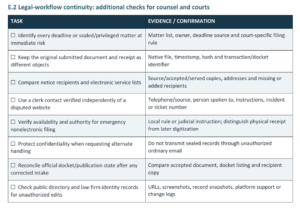
0-V.E.R. INT-DFIR report, p. 49: legal-workflow continuity checks for counsel and courts.
Court authority can be part of cyber containment
The report’s federal analysis also reaches beyond PHP. It examines Microsoft Corporation, Fortra and Health-ISAC v. John Does, the Eastern District of New York action involving cracked Cobalt Strike infrastructure.
Using sworn Microsoft Digital Crimes Unit declarations and the later permanent injunction, the report shows how technical indicators, preservation duties and continuing court authority can be combined in a judicial disruption framework. The point is operational: cyber containment may require both technical control and an adjudicative route capable of preserving evidence, directing providers and protecting unrelated legitimate users.
Earlier Cyber-N.E.T. Forensics publications preserved through Cyber Law Library mapped a cAPTure-to-Kill model linking endpoints, credentials, DNS and mail routing, portals, professional identities and institutional consequences.
The message for the federal courts is not that every website vulnerability reaches CM/ECF. It is that judicial integrity depends on the entire chain by which a person learns where to file, authenticates, submits, receives acknowledgment, is served and later relies on the docketed state. Each handoff deserves its own evidence. During a cyber emergency, continuity requires a route to judicial authority that is independently verified from the channel under examination.
| ABOUT THE CONTRIBUTING AUTHOR
Jay Lewis Farrow is Founder and Chair of NACABAR, Executive Curator of Cyber Law Library, and a legal-sector cybersecurity incident-response operator, researcher and author. His work focuses on advanced persistent threats, digital-evidence integrity, restricted-access portals, professional-identity compromise and cyber-enabled interference with legal proceedings. He served as lead author, research coordinator and final editor of the October 22, 2026 0-V.E.R. INT-DFIR PHP2Shell assessment and develops incident-response and continuity frameworks for legal and court-adjacent environments. |